
How and why TPU cases became dominant for print-on-demand phone cases
By Michel Lindhoud ·
When partners add custom phone cases to their product range, one of the first questions that comes up is: what is the number one phone case that is printed on demand? The answer is TPU phone cases, or as we call them, Soft cases. To understand why and how TPU evolved to become the dominant product, let’s take a look at the past decade.
Where we started
We have been experimenting with printing since 2013 and started out with a product that consisted of a sublimation-printed metal plate that was attached to plastic soft or hard cases. While quick, the product fell short in a few areas:
The back was not entirely transparent, while some designs required that;
When NFC emerged, the metal plates interfered with its functionality;
The product didn’t feel sturdy: back plates could come loose and there were visible margins between the back plate and the case;
It did not cover the entire phone market: the product was only available for popular iPhone and Samsung models.
We experimented with fully printed sublimation cases as well. While a great option that we still offer today, they could not fulfill the market’s demand for TPU cases and did not cover the entire phone market.
The shift to UV printing
Fast forward to 2016: with most people on the street using TPU cases, we knew we needed to find a personalisation solution for them. Because of this, we bought our first UV printer: a Roland LEF-200. This entirely changed our approach and vision.
When we bought the printer, we quickly realised that earning back a €30,000 investment was a challenge. We needed to build systems, which was another investment still ahead of us, while phone cases were selling for just €14.95 at the time. So we built a vision around it: we should be able to offer a case for every device on the market. At that point we shifted to being a print-on-demand company for tech accessories and started approaching other webshops about running their production.
TPU cases combined with UV printing solved several things at once:
We were able to offer a product that customers were actually using most: transparent soft cases.
Time-to-market: we could have a model ready before the actual phone is even launched.
It enabled offering a case for each phone at a competitive price.
This made printing phone cases truly scalable.
To offer these products consistently, though, we needed to understand the material itself. We will cover the printing process and other aspects in separate articles. This one focuses on TPU.
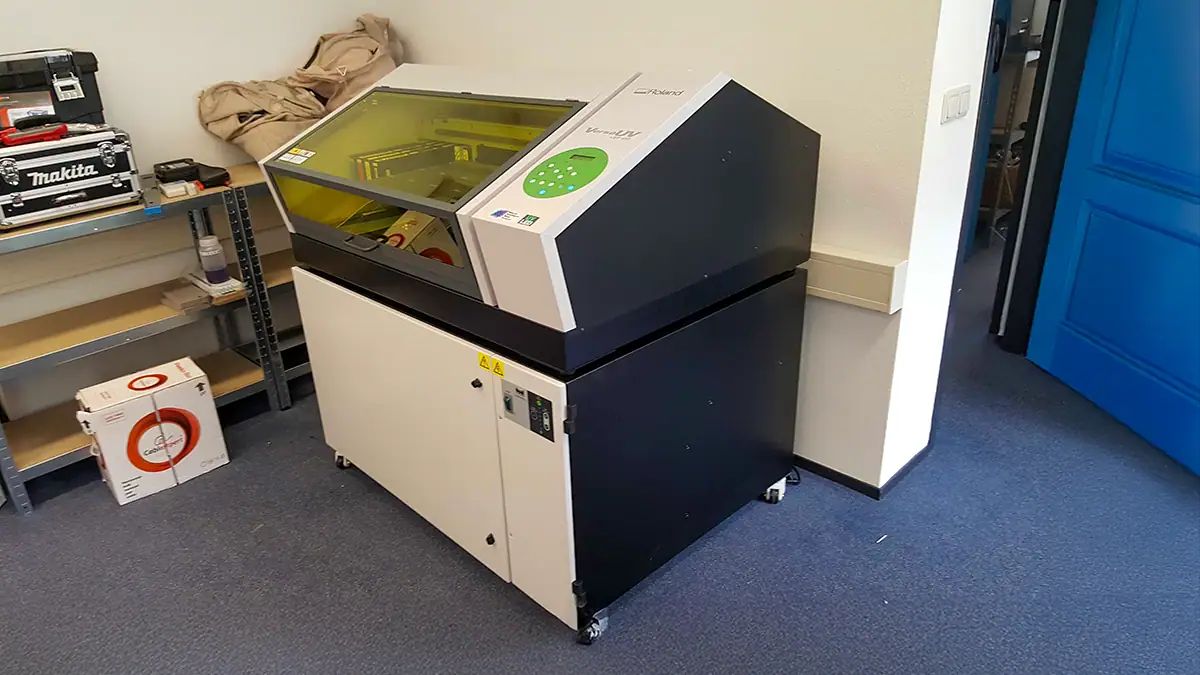
↑ Our first Roland LEF-200 printer ”Van Gogh” in our old building
What is TPU?
TPU stands for thermoplastic polyurethane. It is a type of polymer that sits in an interesting middle ground: it has the flexibility and elasticity of rubber, but can be processed and moulded like a hard plastic. This combination makes it the dominant material for protective phone cases. A TPU case can absorb impact, flex when you snap it onto a device, and return to its original shape without cracking or deforming.
From a material science perspective, TPU owes its flexibility to its segmented molecular structure. It alternates between hard segments, which provide structure and resistance, and soft segments, which provide elasticity. The ratio between these segments can be tuned during manufacturing, which is why TPU cases can range from nearly rigid to very soft, depending on the product specification.
Why TPU is challenging to print on
The same properties that make TPU excellent as a protective case material make it a difficult surface to print on. There are three main challenges:
Surface energy
Flexible polymers like TPU tend to have low surface energy, meaning inks and coatings have a hard time bonding to them. Without proper adhesion, prints will peel, crack, or flake off as the case flexes during normal use.
Dimensional stability
Because TPU is elastic, it moves and stretches. Any print that cannot move with the material will fail at the edges or degrade over time under repeated flexing. Rigid prints on flexible surfaces are a mismatch.
Heat sensitivity
Many traditional printing methods apply significant heat to cure or bond ink. TPU, being a thermoplastic, can deform or lose its structural properties when exposed to temperatures that are too high. This rules out several conventional printing approaches.
Why UV printing is the right fit
UV printing solves all three of these challenges in a way that is specifically suited to TPU.
UV inks cure through a photochemical reaction triggered by ultraviolet light, not heat. This means the substrate is exposed to very little thermal energy during the printing process, which keeps the TPU dimensionally stable throughout.
Modern UV inks formulated for flexible substrates contain additives that allow the cured ink layer to flex along with the material. Rather than forming a brittle film on top of the case, the ink cures into a layer that can stretch and return to shape without cracking or delaminating.
UV printing is also a direct-to-surface method. The design is printed directly onto the case without the need for transfer films or intermediate carriers. This preserves the tactile quality and flexibility of the original material and allows for high-resolution, full-colour output in a single production pass.
What makes a print on a soft case consistent?
A combination of the right ink, the right machine settings, and the right material properties is critical for good adhesion. We have found that if any one of these is off, the quality of the end product suffers.
Over the years we identified four factors that are critical to consistent print quality on TPU:
Always buy the exact same material from the same supplier
When a batch is off, action needs to be taken immediately. One way to verify material consistency is by using a dyne pen, which measures the surface energy of a material expressed in dynes per centimetre. The generally accepted minimum for good ink adhesion is around 38 dyne/cm, with 42 dyne/cm or higher being preferable for UV inks specifically.
Use the same inks and print settings every time
Consistency in process is what guarantees consistency in output. We only make changes after testing sufficient volumes. Our test protocol starts with a few pieces, followed by a large volume of at least 400 items
Keep environmental conditions stable
This is often overlooked, but for UV printing it is important that humidity stays between 40% and 60%. Inks may cure incorrectly outside that range.
Keep the print head as close to the material as possible
If the distance is too great, the result is blurry and the ink may not cure correctly. Setting a clear standard for print head height is essential.
We found that having a reliable supply chain and ensuring that your products are free of dust and oil solves most, if not all, of the problems. That is why we now clean each product with isopropanol before it goes into the printer.
Over the years we expanded our printer fleet significantly. We name all our printers after painters, because after all, they are the ones who paint phone cases. We started with Van Gogh, our first Roland LEF-20, who is still running to this day. Since then we have welcomed Rembrandt, Vermeer, Bosch, Brood, and Dumas on the Roland side, and Ruysch, Knip, Koning, and Leyster among our Mimaki machines. As you may have noticed, we did not stay strictly in the realm of Dutch painters.
Each printer brand uses a different ink set: LUS-120 for Mimaki and EUV-5 for Roland. Every time a new printer and ink set is introduced, it needs to be thoroughly tested with our soft cases to ensure we maintain the same quality standard.
What this means for your products
For our partners, the practical outcome is a printed phone case that holds its appearance over time, resists the small daily stresses of being handled and flexed, and does not require any coatings or laminates that would alter the feel of the case. The print is part of the case, not something sitting on top of it.
At the moment of writing this article we offer a soft case for 395 different phones across 13 phone brands, and the range is still expanding. Check out our product page for more details about the soft case.